
–
–
The modern mind, even at its most intelligent and self-aware, is rarely still. Beneath the surface of our daily routines runs a restless current of desires, anxieties, and calculations – shaped by familiar human preoccupations: safety, social approval, material success, reputation, influence, and control. Even our moments of pleasure are often tainted by the underlying question – how can I hold on to this? How do I get more?
It is through the arts – literature, music, architecture, and visual expression – that we sometimes rise above this conditioned state. When these mediums transcend mere entertainment or emotional stimulation, they offer a portal to something subtler, deeper. In such moments, the mind stirs with a distant memory of stillness – of a consciousness less entangled in craving and comparison. At its highest, art becomes a quiet echo of the mystical.
Mysticism, however, is not mere aesthetic transcendence. It is a fundamental reorientation of consciousness. The mystic does not simply think differently; they are different. Their perception flows from a different center of gravity – one that is not defined by the self, but liberated from it. Yet this state is difficult, if not impossible, to describe using the language of ordinary experience. Mystics speak in metaphors, paradoxes, and silences-pointing not to doctrines, but to direct knowing.
And herein lies a perennial danger: the symbols and sayings of mystics, when stripped of their experiential roots, often become tools of illusion. People may project onto mysticism their hopes for divine intervention, miraculous outcomes, or metaphysical shortcuts to success. The mystic’s invitation to surrender becomes a promise of reward; their insight becomes doctrine; their metaphors become magic.
It is true that some mystics-later canonized as saints or prophets – have been able to communicate a message of love, compassion, and fearlessness to those around them. A few among their followers even managed to live this truth. But over generations, what began as lived insight often ossifies into belief systems, rituals, and power structures. The mystical impulse is rarely scalable, and traditions built around it often become mere shadows of the original flame.
In today’s world – shaped by accelerating technology, algorithmic distraction, economic precarity, and ideological fragmentation – people find themselves more anxious, more divided, and more desperate for certainty. As institutions falter and worldviews clash, many retreat into inherited identities: religious, cultural, tribal. Others seek to evangelise or defend what they perceive as under siege. Both are, in different ways, responses to fear. And fear is the antithesis of the mystical.
The tragedy of modernity is not that we have lost access to mystical states, but that we have drowned out the conditions that allow them to emerge: stillness, silence, inwardness, self-questioning. Our age encourages noise over nuance, spectacle over substance, assertion over inquiry. And yet, beneath the surface, the longing persists – a longing not for more, but for meaning. Not for certainty, but for truth. Not for belonging, but for being.
Perhaps the role of art, philosophy, and contemplative inquiry today is not to offer answers, but to keep this longing alive. Not to lead people toward yet another ideology, but to help them hear what remains unsaid – the quiet call of the real.
#Philosophy #Mysticism #ModernConsciousness #ContemplativeLife #ArtAndSpirituality #InnerJourney #SilenceAndStillness #SpiritualPhilosophy #ReligionAndModernity #MindfulnessBeyondTrends #MysticsAndMeaning #TheSearchForTruth
—
Confession Time 📚🙈
I have never read a Harry Potter book. Yes, you heard that right.
This, despite both my children- Siddharth Ratho and Aditi Ratho – being Potterheads. In fact, Aditi’s devotion continues to this day, long after growing up and acquiring all the signs of responsible adulthood (jobs, deadlines, her own business venture now – and the ability to function without a wand 😀).
I’ve always stood my ground – with this (very grown-up sounding) logic:
“Why read fantasy when real life – and fiction based on it – is already so fascinating?”
To which Aditi would patiently say, year after year, “Just read the first ten pages. You’ll love it.”
I didn’t do it. Not becuase I am stubborn- just… habitual realism 😊. My children even got my late father to read a few Harry Potter books. But I did not relent 😎
But then something magical happened.
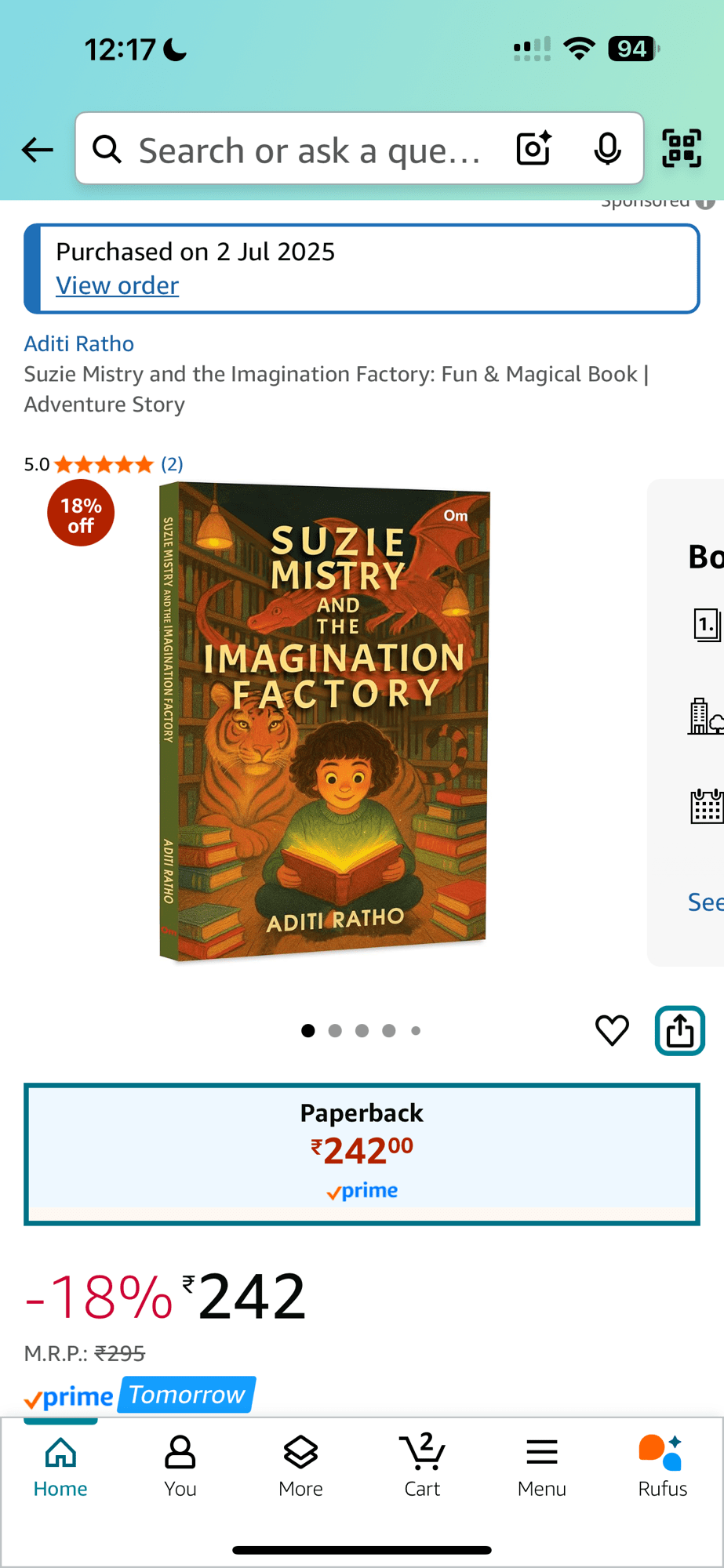
Aditi’s debut novel — Suzie Mistry and The Imagination Factory — got published last week! 🥹💫
I’m immensely proud – the kind of pride that makes you sniff the pages, carry the book around like a trophy, and tell complete strangers, “My daughter wrote this!”..My late father and late father in law must be so proud too – wherever they are.
…At this point, refusing to read my daughter’s book just because I’m “not into the genre” would be… well… churlish (and grounds for family disownment 😄).
So I read the first page.
And guess what? I’m hooked !
Turns out magic runs in the family after all 🤔
Reading it tonight.
And yes, you can find it on Amazon. 😁
History remembers its mass leaders by the size of the crowds they commanded. Socrates, by contrast, left behind no organisation, no movement, no manifesto, and not a single line written in his own hand. He did not seek followers; he sought interlocutors. He did not promise answers; he asked questions. If leadership is measured by mobilisation, visibility, and popular appeal, Socrates was almost its opposite. And yet, few individuals have shaped human thought as enduringly as he has.
This is precisely why a Socrates can never be a mass leader – and why he remains indispensable.
Mass leadership thrives on clarity, certainty, and emotional resonance. It simplifies the world into slogans, symbols, and shared convictions that can be repeated and rallied around. Socrates did none of this. His method was to unsettle, not reassure. Through relentless questioning, he exposed the fragility of received wisdom and the ignorance hidden beneath confident assertions. In a crowd, doubt is contagious in the wrong way; it weakens collective momentum. A mass leader must reduce complexity. Socrates insisted on expanding it.
Moreover, Socrates refused the moral shortcuts that mass leadership often requires. To lead large numbers, one must occasionally overlook contradictions, tolerate convenient untruths, or appeal to passion rather than reason. Socrates was constitutionally incapable of such compromises. His commitment was not to persuasion but to examination. He did not seek agreement; he sought understanding. This made him respected by some, resented by many, and ultimately condemned by the very democracy in which he lived.
There is also the matter of discomfort. Mass leaders offer belonging. Socrates offered unease. His conversations did not end with uplift or affirmation; they often ended in aporia – a state of puzzlement. He made people aware not of what they knew, but of how little they did. Few things are less attractive to a crowd than being told that its certainties are unfounded. A man who makes people uncomfortable for a living cannot hope to lead them en masse.
Yet to conclude from this that Socrates failed as a leader would be to misunderstand the nature of his influence. Socrates did not lead crowds; he shaped consciences. His arena was not the assembly or the battlefield, but the individual mind. He worked one person at a time, patiently dismantling intellectual complacency and ethical laziness. His legacy was not a movement but a method – the habit of critical self-examination.
This is where his enduring importance lies. Socrates represents a form of leadership that modern societies desperately need but rarely reward: leadership without followers, authority without office, influence without spectacle. He reminds us that progress does not begin with mobilisation but with reflection, not with consensus but with honesty. Every healthy society requires voices that resist simplification, that slow down collective enthusiasm, and that insist on asking inconvenient questions.
In times of mass politics and instant opinion, the Socratic presence becomes even more vital. Mass leaders shape the direction of societies; Socratic figures shape the quality of their thinking. Without the former, societies drift. Without the latter, they rush blindly. One provides momentum; the other provides balance.
Socrates was executed not because he threatened the state with rebellion, but because he threatened it with thought. That, too, is instructive. The true danger he posed was not disruption, but introspection. He forced citizens to confront the gap between their professed values and their lived realities. No mass leader can afford to do this too consistently. A Socrates exists to do little else.
In the end, Socrates matters precisely because he does not fit our conventional ideas of leadership. He is a reminder that the most transformative figures are not always those who command crowds, but those who refuse to flatter them; not those who offer certainty, but those who cultivate wisdom. Mass leaders may change the course of history. A Socrates changes the way we think about it – and about ourselves.
I don’t believe that dreams foretell the future, or that they carry messages from some supernatural realm. I don’t treat them as omens, warnings, or encrypted prophecies. They arrive unannounced, perform their brief theatre, and disappear – often before we have had time to take proper note of them.
These days, I make a conscious effort to revisit my dreams – the pleasant ones, at least – before they fade, as remembered dreams almost always do. I replay their images and fragments of conversation, trying to hold them in place for a few extra minutes. Experience has taught me that unpleasant dreams often have less to do with buried trauma than with what I ate or drank the night before, and how much of it. Our biome, our hormones, and the chemistry of our cells exert a far greater influence on both conscious and subconscious life than we usually acknowledge.
Dreams are not messages. They are the subconscious mind doing what it does best: making connections – often random, but rarely senseless. The mind gathers scraps of memory, anxiety, thought, feeling, sensation, and imagination, and stitches them into narratives that may defy time and space, yet remain oddly coherent in their emotional logic.
Carl Jung believed that dreams were not disguises to be decoded but expressions – the psyche speaking to itself in its own symbolic language. One need not accept his metaphysics to recognise the insight. Sometimes these connections expose old fears resurfacing under mental stress or physical discomfort. I have often found myself, in dreams, flying at great speed just above treetops in familiar landscapes, unable to slow down, dodging electrical cables at the last second, or trapped in a cave.
“Dreams are not a different world – they are a more honest one.”
In my experience dreams often do something more generous. They invent situations involving familiar people that unfold in unpredictable yet compelling ways I could never have imagined while awake. Conversations feel uncannily real. Scenes follow their own internal logic. Stories unfold without any obligation to conclude or resolve themselves. In such moments, the dreaming mind behaves like an artist freed from the tyranny of plausibility and utility.
Perhaps both dreams and art (about which I know next to nothing) emerge from the same underground workshop. Perhaps both rely on the mind’s ability to connect distant dots and allow contradictions to coexist. Colin Wilson wrote of consciousness not as a fixed state but as something that expands and contracts, slipping into heightened modes when freed from routine perception. Dreams, in this sense, are not lapses but experiments – brief excursions into alternative ways of seeing.
And then the curtain comes down. We wake up mid-scene, left with a mood, an image, a residue of meaning that resists explanation.
Dreams remind us that even when consciousness switches off, creativity does not. As Nietzsche put it, “We have art in order not to die of the truth.” Maybe we have dreams for the same reason.
Several Indians I spoke with in the past eulogised – or at least empathised with – Donald Trump’s impatience with liberal elites, progressive language, and global institutions that often appear remote from everyday concerns. They appreciated his rejection of political correctness, his scepticism of multilateralism, and his insistence that the USA should pursue its own interests without excessive explanation. His hard line on migration and his explicitly transactional view of alliances were regarded less as moral choices and more as practical ones – an acceptance of how power is said to operate in the real world. When it was suggested that this approach might also normalise exclusion or an unusual tolerance for concentrated wealth and power, the concern was dismissed as overinterpretation.
For some time, this difference of view remained largely theoretical. Trump’s decisions were distant, their effects abstract. It was possible to admire the style without having to account for the consequences. That separation has now narrowed. Following the imposition of steep tariffs on India, alongside a visible warming of relations with Pakistan, earlier certainties have given way to a quieter reassessment. The reaction is not anger so much as puzzlement.
Trump’s distancing from India is attributed, among other things, to our continued purchase of oil from Russia. His renewed engagement with Pakistan appears to rest on considerations that are personal or transactional. This follows years of sustained effort by India to persuade the international community that the Pakistani military establishment has been a principal sponsor of global terrorism. Evidently, some positions are more negotiable than others.
The prevailing mood is one of muted disappointment. There is a recognition -expressed carefully – that admiration does not always invite reciprocity. Yet the broader orientation remains unchanged. Russia may be described as a dependable partner, but it is the United States that continues to be regarded as the more consequential relationship.
Accordingly, Trump’s current posture is being understood as temporary. A phase. An interruption. It is assumed that matters will, in time, correct themselves. Until then, patience is advised.
Tum kisi aur ko chahoge toh,
hum intezaar karenge.
Mushkil hogi toh hone doh.
Every devout Hindu usually has a favourite deity. And every deity, in turn, has one or more places of worship where prayers are believed to be more effective than elsewhere – and therefore worth the time, effort and money they demand. Be that as it may, I have no desire to question the faith of any believer, in any deity, at any place of worship, or even any idea of the divine. If worship gives someone hope, confidence, or the strength to deal with fear and uncertainty, that itself is justification enough.
What does trouble me, however, is the practice of VIP darshan.
It represents a peculiar moral shortcut – a quiet but widely accepted belief that the end justifies the means. That if one can reach the sanctum sanctorum faster by leveraging wealth, status, or connections, then one should. It is an approach to worship that fits into no precept of any scripture I am aware of, and certainly into no idea of humility that religion so often preaches.
The stated logic is usually practical: time is precious; queues are long; responsibilities are many. And yet, when one looks closely, the logic is not very different from the one used to justify cutting corners elsewhere in life. What makes it unsettling is not merely the bypassing of the ordinary devotee – standing patiently for hours, sometimes days – but the absence of any discomfort about it.
Instead of guilt, what I often see is pride.
There is pride in recounting how effortlessly one “managed” darshan. Pride in knowing the right person, paying the right amount, or belonging to the right category. Pride, even, in narrating the impatience one was spared. The queue, it seems, is for others – anonymous, faceless, dispensable. The deity, apparently, understands.
But what is being sought in that hurried moment before the idol? Grace? Blessings? Inner peace? Or simply the satisfaction of having completed a transaction efficiently?
Religions across traditions speak of equality before the divine. Of surrender. Of ego dissolving at the threshold of the sacred. And yet, VIP darshan institutionalises hierarchy at precisely that threshold. It converts faith into a fast-track system and devotion into a premium service.
One might argue that the deity does not discriminate; that these are merely human arrangements. That may well be true. But then the question shifts – from what God thinks to what we are willing to accept about ourselves.
If standing in a queue with strangers tests patience, empathy, and humility, perhaps that too is a form of prayer. And if bypassing it flatters our sense of importance, perhaps that too reveals something – but not about the divine.
When I first read When the Shoe Fits nearly twenty years ago, it left a profound and lasting impression – a further shift in my understanding of life, freedom, and the subtle tyranny of power. Osho’s luminous interpretation of Lao Tzu revealed a world where control dissolves, and liberation begins, where the ordinary rhythms of life carry within them the extraordinary secret of being.
Osho invites us to witness the illusions of power: the hunger to dominate, to be recognised, to impose our will. “Power is violence,” he says, “even when it is subtle, even when it hides behind virtue. Freedom is the fragrance that comes when all such ambition has withered away.”
In a society that worships authority, achievement, and influence, these word remind us that the true kingdom is within; that our restless striving often blinds us to the simplicity of being. Through his parables, Osho illustrates that life’s wisdom is often hidden in ordinary acts. The cobbler who knows the measure of the foot better than the emperor’s tailors becomes the symbol of one who has found the right “fit” in life. “When the shoe fits,” Osho writes, “the foot is forgotten.”
So it is with life: when we live attuned to our own nature, effort dissolves, and being flows effortlessly, unburdened. Osho continues:
“Easy is right. Begin right and you are easy. Continue easy and you are right.”
Here is the paradox: the one who grasps power is entangled, but the one who lives with ease is free. Osho reminds us:
“You are, but there is no ‘I’. It is a simple ‘am‑ness’, an ‘is‑ness’, but there is no ‘I’, no crystallised ego.”
When the heart is right, opposition falls away:
“So, when the shoe fits, the foot is forgotten; when the belt fits, the belly is forgotten; and when the heart is right, ‘for’ and ‘against’ are forgotten.”
And what is that right heart? It is the heart that ceases to fight itself, the heart that no longer clings to “for” or “against,” but rests in simple being.
This is the heart of freedom – not freedom as a prize, not freedom as a conquest, but freedom as the natural ground. It is not something to claim; it is something to uncover. Osho writes:
“Life is a mystery, not a riddle. It has to be lived, not solved.”
In today’s world of constant endeavour and self‑promotion, When the Shoe Fits offers an antidote: a reminder that simplicity is not weakness, surrender is not defeat, and the highest mastery is to renounce the very notion of power.
“Don’t help anybody’s expectation of you to grow… Drop fulfilling others’ expectations, and drop expecting others to fulfill yours.”
In the end, it invites us to return to our natural rhythm, to live authentically, to trust that when the shoe fits, we need no crown, no throne, and no applause – only the quiet joy of being fully at ease with ourselves.
—
To be human is to live between two silences – the one before birth and the one after death. Between them stretches a brief, shimmering interval called life, filled with music and dissonance, laughter and ache. We walk this narrow bridge between joy and sorrow, light and shadow, and in that very balance lies the beauty of being alive.
Albert Camus once wrote, “In the depth of winter, I finally learned that within me there lay an invincible summer.” That invincible summer – that inner flame which refuses to die – is what the Bhagavad Gita calls the Atman, the self untouched by fortune or loss. When Arjuna falters on the battlefield of doubt, Krishna reminds him that the soul is eternal, unshaken by circumstance. The true battleground, then, is not outside us, but within – between fear and faith, between the pull of desire and the whisper of wisdom.
Suffering is not an error in the design of existence; it is the pulse of awakening. The Buddha, sitting beneath the Bodhi tree, saw that dukkha – suffering, impermanence, and unsatisfactoriness – is woven into the fabric of life. Yet he also taught that liberation lies not in denial but in awareness. “Pain is certain,” he said, “suffering is optional.” The wound is inevitable; what is optional is our attachment to it. When we stop resisting life’s impermanence, suffering loses its sting and becomes the raw material of freedom.
Joy, too, is not the absence of sorrow but its twin. Khalil Gibran understood this when he wrote, “The deeper that sorrow carves into your being, the more joy you can contain.” Joy is not always loud or luminous; it often comes quietly, in the pause between two storms – in the laughter that escapes through tears, in the grace that follows surrender.
Rabindranath Tagore captured this balance with haunting simplicity:
“Let me not pray to be sheltered from dangers,
but to be fearless in facing them.
Let me not beg for the stilling of my pain,
but for the heart to conquer it.”
Freedom, then, is not escape from life’s contradictions but participation in them with open eyes. The Gita calls it nishkama karma – to act with full heart and yet remain unattached to outcome. Epictetus, the stoic philosopher, echoed this across continents and centuries when he said, “No man is free who is not master of himself.” Freedom is not given by destiny or denied by suffering; it is the stillness with which we meet what is.
There is another kind of freedom, gentler and more enduring – the freedom to love life despite its fragility. To look at the world, knowing it will one day vanish, and still say yes. This is not resignation but grace. It is what Tagore called ananda, the quiet joy that rises when we stop grasping and begin to live in presence. It is the light that flickers not in victory, but in acceptance.
We walk, then, across the uneven floor of existence – sometimes dancing, sometimes stumbling, yet always moving. The cracks beneath our feet are not flaws; they are the lines through which light enters.
To be human is to hurt, to hope, and to rise again. To carry sorrow without surrendering to it. To taste joy without clutching at it. To live, fully and freely, in the space between the two silences.
————-
 An ordinary life