An era has ended in Cuttack. Raghu, the humble custodian of the city’s most beloved street food, has passed away. For nearly six decades, his dahibara aloo dum has not merely been food, but a ritual, a memory, and a binding thread across generations of dedicated fans who queued up eagerly for that leaf cone of baras soaked in tangy curd and topped with his fiery aloo dum.
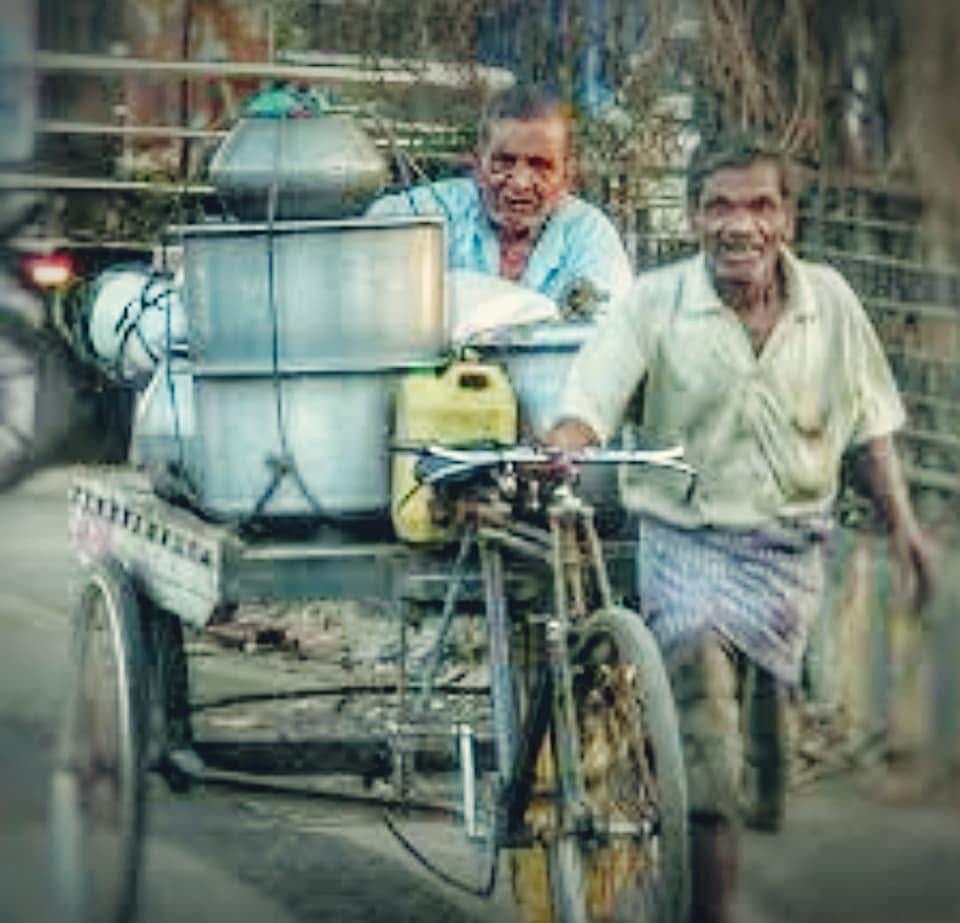
Over the years, little ever changed. Evening after evening, Raghu would arrive punctually at his fixed spot – first near Barabati Stadium when I was in school, and later in Bidanasi – bringing with him a set quantity of dahibara and aloo dum in large aluminium dekchis, carefully balanced on a cycle rickshaw. The aloo dum always retained its warmth till the very last ladle, not because of insulation, but because it vanished so quickly into waiting hands.
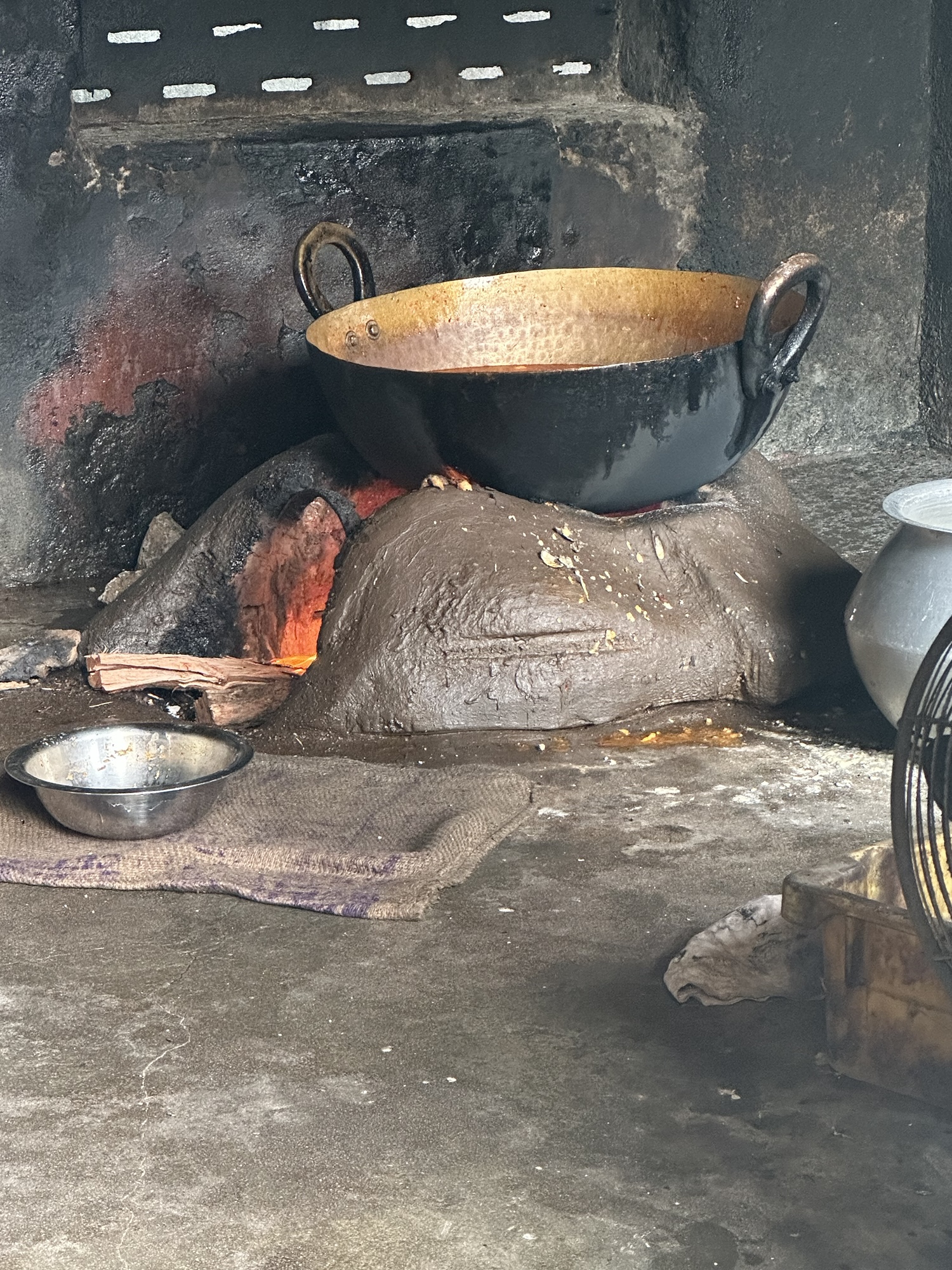
This summer, I finally made a pilgrimage of sorts to his home. A young and enthusiastic guide, Chris, led me down a quiet, winding lane dotted with contemplative cows, to the kitchen where this legendary dish had been prepared day after day, year after year, with unwavering precision. One of his sons was tending to the simmering aloo dum over a crackling wood fire, while another was preparing the paraphernalia for the daily journey to Bidanasi. And there was Raghu himself- bare-chested, in a simple lungi, lying on the floor in gentle repose under the shade of the courtyard. A picture of humility, almost blending into the rhythm of his household, yet filling the space with an unmistakable aura.
The wood fire that gave his aloo dum its earthy warmth, the blackened kadhai that had witnessed countless afternoons of stirring, and the heap of red chillies drying in the sun -all of it transported me beyond the sweltering heat into a state of quiet ecstasy. It felt less like a visit to a kitchen and more like the culmination of a pilgrimage.
Raghu was never one for flamboyance. He let the food speak for him. And speak it did – in the satisfied sighs of teenagers, in the hurried steps of office-goers grabbing a plate before dusk, and in the nostalgia of old Cuttackias returning from afar who felt instantly at home with that first bite. His gentle words and quiet smile became as much a part of the experience as the dahibara aloo dum itself.
Now, Raghu has passed, and with him goes a part of Cuttack’s living heritage. Yet the flame of his legacy will not die. His sons, already carrying forward the craft with care, will ensure the queues remain, the flavours endure, and the tradition continues.
Raghu’s physical presence may no longer grace that lane or his spot in Bidanasi, but his spirit will linger – in the aroma of tangy curd, in the fiery bite of aloo dum, and in the collective memory of a city and its diaspora .
Raghu is gone. But every time someone who has been in his presence , bites into dahibara aloo dum anywhere in the world, Raghu’s quiet, humble aura will be there.
—
Remembering Raghu Bhaina | His Dahibara Legacy Stays Eternal
I met him first when I walked up to the reception desk at the Lal Bahadur Shastri National Academy of Administration in August 1986. He was standing nearby, peering intently at a register. Turning around, he extended his hand with a smile and said softly, “Keshav.”
He was older than me, dressed nattily in a tweed jacket, corduroy trousers, and a rather dainty silk scarf. His tousled hair and twinkling eyes behind his glasses gave him a distinguished yet approachable air. I introduced myself, still unsure who this gentleman was. Keshav nodded, said, “I’ll see you tomorrow,” and walked away, humming a tune -lost in his own thoughts, unhurried, as if he had all the time in the world. It was a sight I would grow familiar with in the weeks to come.
The man I had met at the reception – Keshav Desiraju -was a civil servant himself, serving as the course director at the training academy for new recruits like me. The academy was located in Mussoorie, a British-era hill station known, among other things, as the hometown of Ruskin Bond, the beloved Indian author who writes in English.
I was 24; Keshav, in his mid-thirties, was already a “seasoned” civil servant. Unlike some of the other instructors /charismatic, larger-than-life figures who regaled us with tales of their adventures and achievements – Keshav was unassuming, shy, and soft-spoken. Everyone liked him, but he wasn’t necessarily seen as a role model in the way some of the more flamboyant officers were. He rarely used the first-person singular, except in a self-deprecating manner.
In some ways, Keshav was an odd man out in that environment. Yet, I never heard anyone speak ill of him – then or later. He was always well-liked, though never hero-worshipped.
A few weeks into the course, a handful of us, including me, took up Keshav’s open invitation to drop by his cottage in the evenings if we wanted to discuss anything. We knew he was single, so we wouldn’t be intruding.
My first visit to Keshav’s home, a quaint cottage standing alone a short distance from the academy, was a delightful surprise. His cozy space was filled with books, vinyl records, and art. It felt like stumbling upon hidden treasures. A jigsaw puzzle on a table lay half-finished. I was fascinated – not just by the surroundings but by the many layers of the man I had so far only encountered in the formal setting of the training academy.
Keshav’s hospitality was warm and effortless. The delicious South Indian vegetarian food he served paired surprisingly well with the wine from his modest but thoughtfully stocked bar. We were hungry and thirsty greenhorns, and he indulged us with kindness and gentle laughter. I soon became a regular. Being somewhat quiet myself, I simply soaked in the atmosphere – scintillating conversation, good music, and Keshav’s easy companionship. When he discovered my love for jazz, he made sure to play it whenever I was around.
Keshav came from a family of renowned scholars and civil servants. His maternal grandfather, Dr. Sarvepalli Radhakrishnan, was a philosopher and India’s second President. Keshav himself had studied at Cambridge. Yet, while his family legacy and intellectual depth left some of us in awe, he wore it lightly. His humor was wry, his generosity boundless, and his concern for us always genuine.
I felt very close to Keshav and enjoyed his company. He seemed to enjoy mine as well. He could make sly, even mischievous, observations about people, but never in an unkind or judgmental way. Despite his uncompromising ethics, he carried no bitterness.
After our training in Mussoorie, Keshav, who had been on temporary deputation to the academy, returned to his original cadre. Over the years, he held key positions in the governments of Uttar Pradesh and later the Union (federal) Government of India until his retirement.
I have always been somewhat of a loner, which made me admire how Keshav, despite being an introvert, managed to stay in touch with so many friends across different walks of life. We didn’t meet often – only when work brought him to Mumbai or me to Delhi – but our bond remained strong. Keshav never married. I suspected that the women he would have liked to marry were either already taken or that he had waited too long, unable to overcome his shyness.
At some point, without even realizing it, Keshav became my pole star. Throughout my career in the Indian Administrative Service, whenever I faced a difficult decision – particularly when my sense of public duty clashed with the demands of an elected politician – I would ask myself, What would Keshav do? I hardly ever discussed these dilemmas with him, yet he had become my internal compass for integrity and honesty.
Once, I was offered the role of private secretary to a minister in the Union Government in New Delhi. It was considered a prestigious position for a young civil servant, given the perks and influence that came with it. I called Keshav for his opinion. He asked me just one question: “Would you find job satisfaction working under a minister who has not distinguished himself in any way?”
His words were a damper, but I immediately understood his point. I declined the offer.
Keshav himself paid a price for his integrity. Towards the end of his career, as Union Health Secretary, he was transferred because he refused to accommodate his minister’s wishes on a matter of principle. He moved on quietly, without protest, as always. He shunned publicity, but his work left a lasting impact, earning him deep respect from colleagues and admirers alike.
His contributions to mental health awareness in India and the establishment of institutions to address its challenges were extraordinary. He would have done much more had it not been for the ego of one minister and the indifference of the system. I understood this well – as a civil servant myself, I had seen how many idealistic and principled officers in India’s still-young democracy faced similar situations. Some gave up, some became martyrs, and some compromised their principles in exchange for a safe, smooth, and sometimes lucrative career.
When we did meet, we rarely spoke of serious matters. Instead, we discussed books. He was always ahead of me in the number he had read. A role model yet again.
After retirement, Keshav moved from Delhi to Chennai, where he lived alone, devoting his time to reading and writing. His deep love for Carnatic music led him to write a biography of the legendary singer M.S. Subbulakshmi, in addition to numerous articles on various subjects.
Every year on September 5th, India’s Teachers’ Day – celebrated in honor of his grandfather, Dr. Radhakrishnan – I made it a point to wish Keshav. A few years ago, just days before I could send my message, I received the shocking news that he was gone. By all accounts, he had seemed fit and fine, but a massive cardiac arrest ended his life.
Only a month earlier, during a long conversation, I had promised Keshav that once COVID-related restrictions were lifted, I would visit him in Chennai for a few days. He was pleased, and I was excited at the prospect of finally catching up with him in a real sense after all these years.
Even now, I sometimes imagine spotting Keshav from behind in an unfamiliar city or along a mountain path. I see myself catching up with him, walking alongside him, mirroring his unhurried pace – soaking in the sights, the sounds, and the scents – searching for the right words to describe the journey.
My father’s elder sister Padmalaya Das, who was fondly called Mami Nani by almost everyone in our extended Ratho family had no children of her own. I don’t know if that was a reason why she showered her love so generously on her nephews and nieces. Maybe not. Maybe she was just born like that. Some people are.
Mami Nani’s house in Cuttack was so full of books and papers, because both she and her husband were bibliophiles, that there wasn’t much space left to entertain guests. But she did. She would invite us in ones and twos and cook delightful meals for us. Her little abode, accessible through a flight of narrow winding stairs was an island of peace and love.
I was fascinated by Mani Nani’s love for books and her anecdotes. . She wrote very well too – in English. Her style was fluid and her humour gentle. Her column Cuttack Notebook, published regularly in the 1970s in the Hindustan Standard newspaper ( published in Calcutta) was a delight to read – even for youngsters like me. While she favoured fiction , her husband Mr GN Das read serious books on Anthropology and allied subjects. He was a proud and brilliant man from an aristocratic family who never took up a job. He was too busy researching esoteric subjects like the history of cyclones and embroiled in litigation over ancestral agricultural lands. Mami Nani and he led simple and peaceful lives unadorned by material possessions like motor cars but she never seemed to envy the relatively less modest lifestyles of her brothers. She loved everyone and everyone loved and respected her. Her life was devoted to social work and she was associated with many NGOs, local and International.
There is a special reason for remembering Mami Mani on the occasion of Raksha Bandhan. She would come unfailingly on that day every year to tie Raakhi around the wrists of her brothers – and her Bhabis ! And there were always little goodies for the nephews and nieces. I really don’t remember the goodies but I do remember her smiles and her soothing voice and her love of books .
Mami Nani left us somewhat early. I think of her often. Especially on the occasion of Raksha Bandhan.



 An ordinary life