I like to believe I’m an adventurous eater. I’ve tried stinky (fermented) stuff, eaten every kind of salad to ease the conscience (ahem), indulged in bites of forbidden succulence—and even flirted (recklessly) with a raw herring once.
But no matter how many stamps the passport gets, there are some flavours I keep returning to- the ones that feel like home.
Here’s a long (but far from exhaustive) list of Indian dishes that sit at the top of myvpalate-not in any particular order, because how does one rank comfort, memory, and masala?
South Indian Staples I’d Fight For (Gently):
• Idlis with sambhar and coconut pachidi – soft, spongy clouds of calm.
• Malabar parathas – layered, flaky indulgence.
• Kara Kuzhambu and Chettinad chicken from Tamil Nadu – spicy, complex, unforgettable.
• Andhra favourites like Gongura mutton and Pesarattu – bold, punchy, and unapologetically proud.
• Avial, poriyal, kootu – Tamil Nadu’s lesson in how vegetables can dance.
• Curd rice – the unsung lullaby of the South, cooling, calming, complete.
• Pokhalo bhaat – Odisha’s summer salvation: fermented rice, curd, mustard oil and humility in a bowl.
Meat That Deserves a Standing Ovation:
• Mutton Dum Biryani – drama in every grain.
• Kadhai Chicken – for the masala-fix days.
• Lal Maas – fire and finesse.
• Kashmiri Rogan Josh and Gushtaba – velvety, royal, soul-stirring.
• Gongura Mutton (yes, again. It deserves it).
• Salli Boti, Patra ni Machhi, and Dhansak – where the Parsi kitchen turns fusion into fine art.
• Champaran Mutton from Bihar – slow-cooked in mustard oil and sealed pots; smoky, tender, and irresistible.
• Kolhapuri Mutton Rassa (Tambda & Pandhra) – two gravies, one spicy red, one creamy white. A fierce and flavourful duo.
• Saoji Mutton from Nagpur – dark, dry-roasted, intensely spiced. Not for amateurs.
• Mutton Sukka – dry, masala-laced comfort from coastal Maharashtra or Karnataka.
• Bhakri with Mutton Lonche – spicy mutton pickle paired with rustic millet bread.
Saltwater & Sweetwater Blessings- Because We Love Both:
• Maccha Besara – Odiya-style river fish in mustard and garlic – rustic, pungent, perfect with rice.
• Rohu in Aloo Jhol – the everyday fish curry that’s never boring.
• Macha Tarkari – fish cooked Odiya-style with vegetables and subtle spice.
Veg Dishes That Don’t Need Meat to Impress:
• Kanda Poha, aloo parathas, sattu parathas – Indian breakfasts that fuel revolutions (and sometimes mid-morning naps).
• Ker sangri, Gatte ki sabzi, lehsun chutney – Rajasthani resilience on a plate.
• Dalma and Santula from Odisha – gentle, grounding, quietly brilliant.
• Shukto and Aloo Posto from Bengal – bittersweet, poppy-laced poetry.
• Khar and Ou Tenga from Assam – earthy, tangy, and refreshingly different.
• Aloo ke Gutke from Uttarakhand – fried pahadi potatoes with jakhya seeds, small-batch magic.
• Thukpa from Nepal – a hearty, slurpy noodle soup that warms hands and hearts.
And the Ever-Dependable Comfort Crew:
• Kolkata-style rolls (wheat base) – eggy street magic that no burrito or wrap can match.
• Egg fried rice – the universal backup plan.
• Dal Tadka – the humble hero.
• Pickles from every corner of India – mango from Andhra/Southern Odisha, red chilli from Rajasthan, garlic from anywhere, gongura from Telangana, kathal from Bihar… bottled with love and a warning.
• Odiya & Bengali sweets – where sugar doesn’t shout, it sings.
So yes, I’ll still try strange sauces in foreign lands and pretend to appreciate undercooked stuff, but when it comes to true, undying love…
Give me mustard oil, give me garlic, give me heat, give me home.
And if it’s fusion : O Pedro ( in BKC Mumbai is my favourite. They do not carried away by experimentation )
#FoodIsHome #GlobetrotterWithAPickleProblem #DesiAtHeart #IndiaOnAPlatter #CurdRiceOverCaviar #MasalaBeforeMinimalism #Trishna # O Pedro
After a berry smoothie and scrambled eggs with avocado and asparagus Satiated my cardio driven hunger and my conscience, I was checking out a book online Inspired by a friend’s fb post on Rumi and Shams.
I decided then that a shot of espresso at Nandan Would help the stream of consciousness to have a longer run
As I was leaving Cou Cou I decided to ask for the name of the Maltese cutie Who was subjecting the menu to such close scrutiny
And believe you me She is called Rumi !
At Nandan, as I contemplated the idea of serendipity Another beauty appeared with an air of levity
She is called ginger not Shams Such a pity
But serendipity is serendipity
So how about ginger espresso instead of ginger tea ?!
I make myself a cup of coffee every morning, beginning with the grinding of beans. I did that a bit late today, when I took a break after reading half of Aditi Ratho’s book for children at one stretch. The reading – and of course, the caffeine hit – made me think.
“Will literature decline with the advent of AI? Is literature still important for humankind or will it just be a mere hobby for some sedentary people?”
These aren’t questions one typically asks after reading a children’s book. But then again, a good children’s book often has the power to remind us of all that is pure, profound, and quietly revolutionary.
What struck me was this: in a world racing towards automation, simulation, and instant everything, here was a book that slowed me down. It asked for imagination, not interaction. It offered delight, not data. It nudged the mind gently, instead of overwhelming it with options.
So, will literature survive the age of AI?
Perhaps not in the way we’ve known it. Mass-market writing might become more formulaic, more tailored to metrics and mood graphs. Instant plots, hyper-personalised endings, AI-generated novels with chapter-wise sentiment analysis. All perfectly possible.
But literature – true literature – was never about utility. It’s about us. Our contradictions, our wonder, our madness, our silences.
AI can simulate a story. It can even write a beautiful sentence. But can it write from heartbreak? From longing? From memory blurred by time and scented by nostalgia?
Can it make a child laugh and make a parent pause to think?
Can it surprise you not just with what it says – but why it says it?
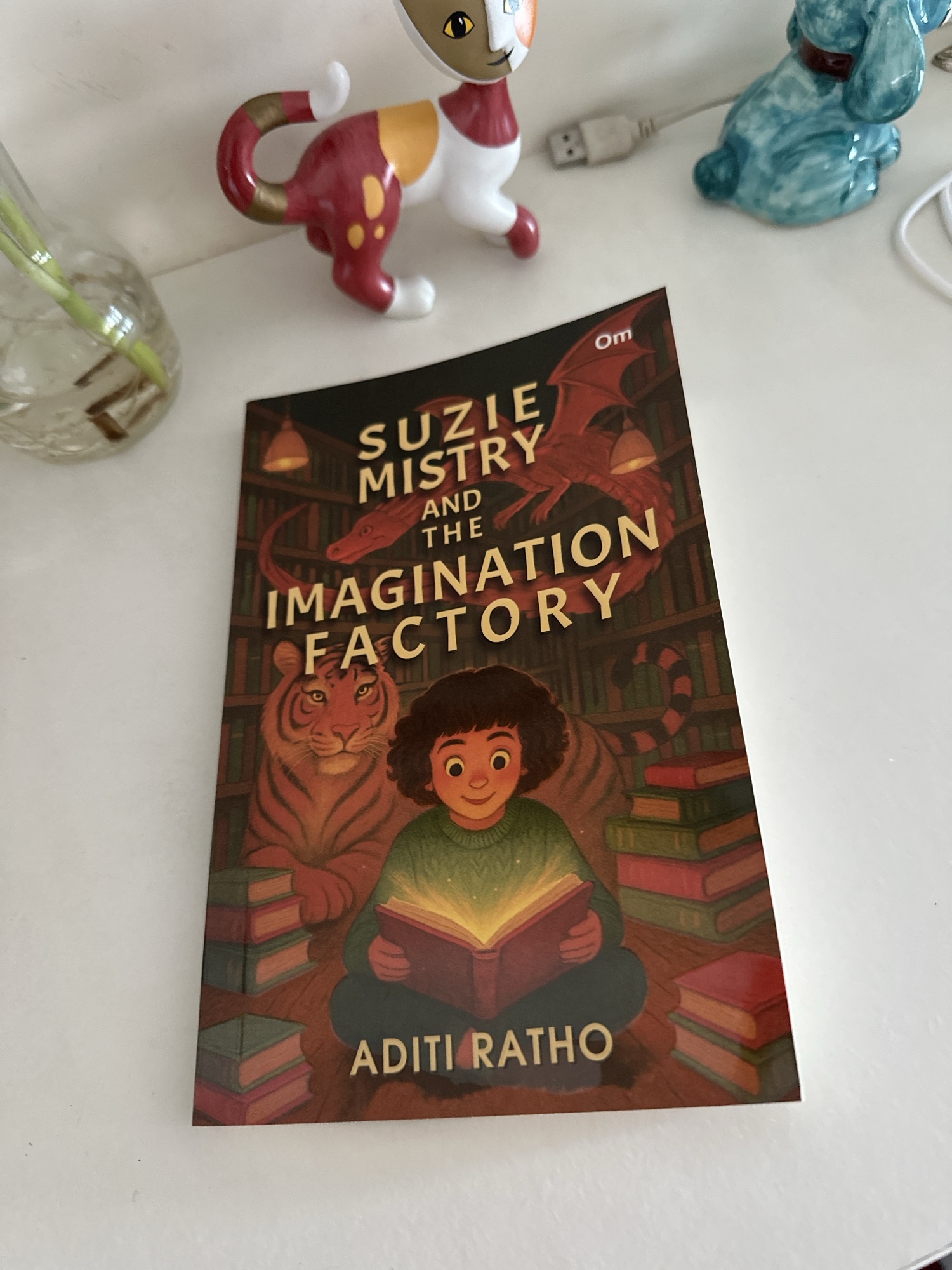
Reading Aditi Ratho’s freshly published book ( Suzie Mistry and The Imagination Factory ) reminds me that the spark of literature lies not in sophistication but in soul. And for that, you need a beating human heart, not just a brilliant algorithm.
So maybe literature will become a niche hobby. But it won’t be because of AI. It’ll be because we stop making time for it.
And that, like missing your morning coffee, would be a shame.
—
Now back to the book. There is dragon waiting in the next chapter 😊
I have never read a Harry Potter book. Yes, you heard that right.
This, despite both my children- Siddharth Ratho and Aditi Ratho – being Potterheads. In fact, Aditi’s devotion continues to this day, long after growing up and acquiring all the signs of responsible adulthood (jobs, deadlines, her own business venture now – and the ability to function without a wand 😀).
I’ve always stood my ground – with this (very grown-up sounding) logic: “Why read fantasy when real life – and fiction based on it – is already so fascinating?” To which Aditi would patiently say, year after year, “Just read the first ten pages. You’ll love it.” I didn’t do it. Not becuase I am stubborn- just… habitual realism 😊. My children even got my late father to read a few Harry Potter books. But I did not relent 😎
But then something magical happened. Aditi’s debut novel — Suzie Mistry and The Imagination Factory — got published last week! 🥹💫
I’m immensely proud – the kind of pride that makes you sniff the pages, carry the book around like a trophy, and tell complete strangers, “My daughter wrote this!”..My late father and late father in law must be so proud too – wherever they are.
…At this point, refusing to read my daughter’s book just because I’m “not into the genre” would be… well… churlish (and grounds for family disownment 😄).
So I read the first page. And guess what? I’m hooked ! Turns out magic runs in the family after all 🤔
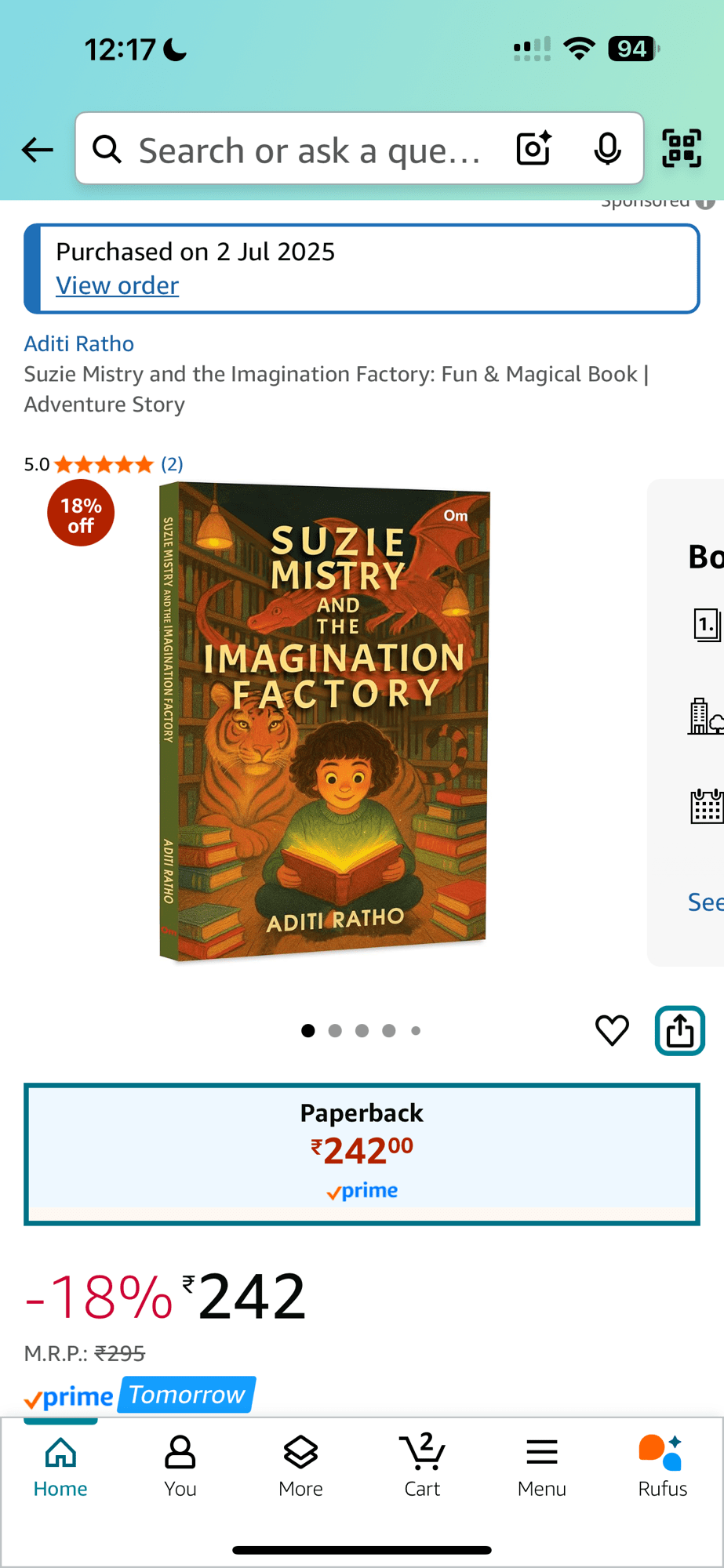
Reading it tonight. And yes, you can find it on Amazon. 😁
I was never very interested in travelling for sightseeing. Partly because I assumed that’s what travel was all about – seeing monuments, ticking off tourist spots, and posing near “must-see” sights. And since I hadn’t travelled much, I didn’t feel like I was missing anything.
After all, you can read about countries. Watch documentaries. Zoom in on Maps. What more could travel offer?
And yet – whenever I visited a new town, a remote village, or even someone else’s home in a different setting, something shifted inside me. I used to think it was just the novelty of being on a trip that I enjoyed -and that the serious pursuit of travel wasn’t worth the time, money, or effort.
Especially because I wasn’t -and still am not- into sightseeing. (Or being seen near sights!)
And if all one wants is do is to eat, drink and relax with family or friends, then one resort is as good as another. The location hardly matters.
But over the years, through journeys prompted by work, family, friends – and now, occasionally, by my own curiosity – I’ve come to realise something:
Travel does recharge my batteries. But more importantly, it expands my mind. Not despite skipping the sightseeing – but because I do.
And it’s often the small things: A brief conversation with a stranger. Observing how people move, speak and smile. Noticing how a community, a sreet or a city wakes, breathes, walks, eats, drinks, works and unwinds Watching how people watch over their children in a park Watching how dogs greet and meet
“Travel isn’t always about distance. Sometimes it’s about perspective.” – Anonymous
When you’re not rushing from one attraction to the next, you start noticing the texture of life: • How do people greet each other ? • What does a quiet evening sound like ? • What do people complain about? What do they celebrate? • What do their markets smell like? • What expressions do people wear – on the streets, in cafés, in museums, on crowded trains?
When people ask me about all that I saw or what Ivdid after I return from longish travels, I often find it difficult to answer 😊.
So here’s what I ask you.
Is travel just about “seeing the world”? Or is it about learning to see differently? Can we travel not to escape life, but to witness how life is lived elsewhere? Is it okay to skip the brochure-worthy sights – and still return with insight? Is it a good idea not to seek out the familiar when one travels – ‘ our’ food and ‘ our’ people ?
I think so. Do you ?
“One’s destination is never a place, but a new way of seeing things.” -Henry Miller
Let me know what you think – and what kind of travel has changed you.
For millions of working people in Indian cities, street food vendors are more than a convenience-they’re a lifeline. Affordable, accessible, and often delicious, these vendors serve the city in more ways than one.
And yet, despite legislation championed by well-meaning activists, and progressive judicial pronouncements-like those from the Bombay High Court-the lived reality of street vendors remains precarious.
They continue to be treated as encroachers by city planners and administrators. Ironically, even those with hearts bleeding for environmental, gender, or human rights causes often look past (or away from) the rights of the people feeding the city from its pavements.
Over the years, a few officers at the helm in the BMC have crafted schemes to accommodate street food vendors with sensitivity – and due regard for hygiene . Judges have issued detailed orders to balance livelihood and urban order. And yet, on the ground, very little has changed.
The truth is: Indian cities still haven’t figured out how to plan with the informal sector instead of despite it.
A fundamental shift is required – from managing street vendors as a “problem” to recognising them as part of the solution to urban hunger, unemployment, and even safety.
After all, a vibrant and safe street is a lived-in, watched-over, and easily fed street.
And sometimes, it’s also where joy quietly arrives in a rain-drenched city :
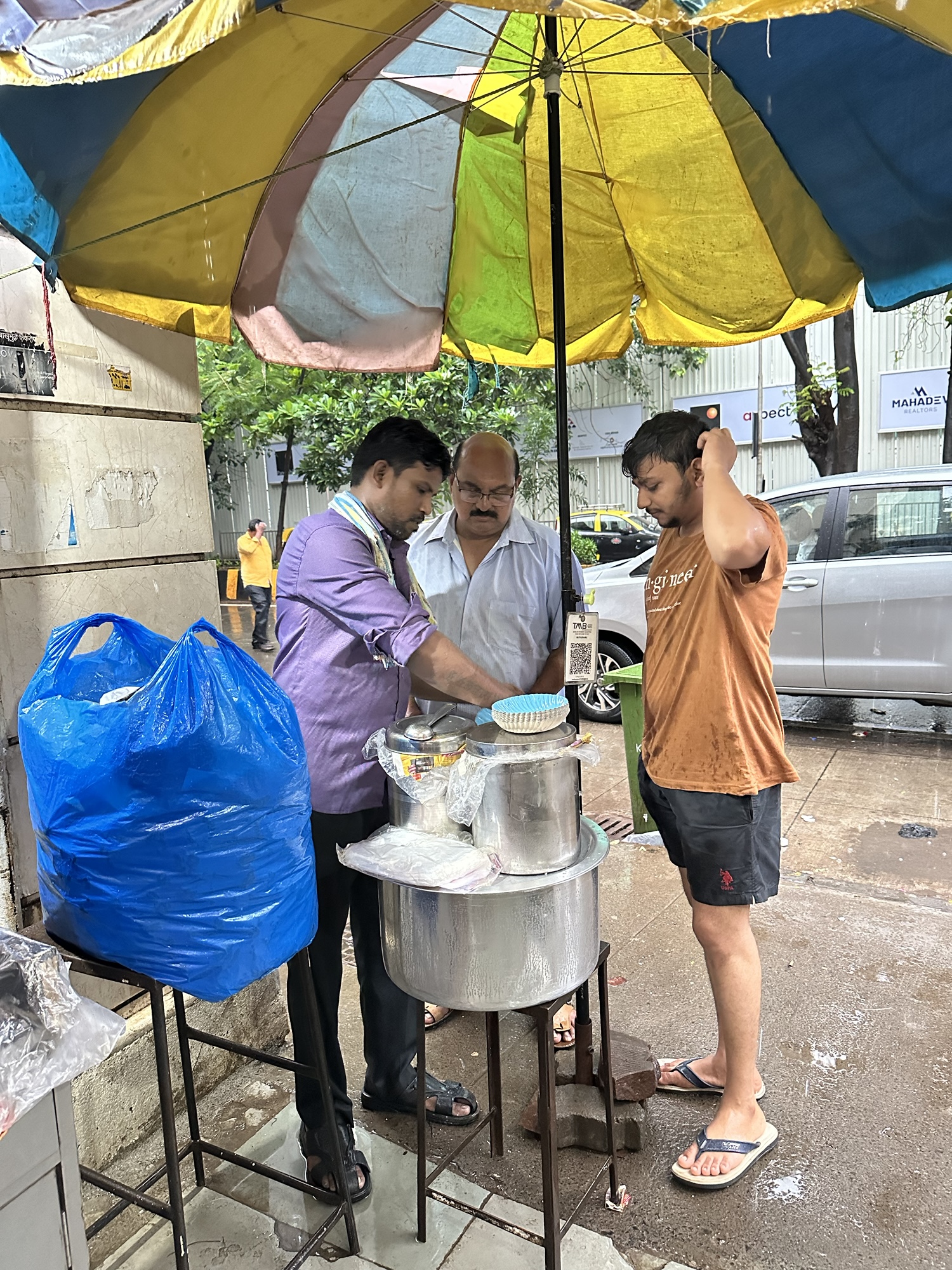
Despite early morning showers in Mumbai today, I made my way through Kalanagar to pick up breakfast from a vendor as a surprse for my wife.
Muthuram arrived in a kaali-peeli cab all the way from Dharavi, carrying snow-white idlis and two kinds of chutney in large stainless-steel containers . The aroma of the soft idlis and the bold spices in the chutneys cut straight through our jet lag – bringing joy and the unmistakable flavour of the country we call ours . 😊
For centuries, science and technology -paired with the engines of enterprise, whether public or private -have propelled humanity forward. From the industrial revolution to the digital age, our ability to harness innovation has created wealth, expanded life expectancy, and improved the ease of living in ways our ancestors could never have imagined.
Artificial Intelligence is the next frontier in this journey. Its potential to optimise systems, personalise services, accelerate discovery, and transform industries is both exhilarating and undeniable. In areas ranging from healthcare and logistics to education and finance, AI promises to deliver faster, cheaper, and often better solutions. Even the business of entertainment -once the stronghold of human whimsy and imagination -is already seeing disruption through synthetic voices, AI-generated scripts, personalised content, and immersive virtual experiences.
And yet, as the biblical wisdom reminds us, “Man does not live by bread alone.”
A higher standard of living does not automatically translate into a higher quality of life. Wealth and convenience may add comfort, but they do not guarantee meaning. While machines may be trained to simulate emotion, they cannot yet feel it. While they may reproduce the patterns of human creativity, they do not suffer, yearn, laugh, or long for transcendence.
In an age of AI-generated poems and paintings, the human soul still seeks something else -authenticity, connection, purpose. These are not just data points to be predicted, but lived experiences to be understood.
This doesn’t mean AI is the enemy of meaning -far from it. It can be a powerful ally in expanding access to knowledge, preserving heritage, and enhancing human creativity. But it must remain a tool, not a replacement, for the very things that make us human.
As we race ahead in our pursuit of innovation, we would do well to ask not just what we can automate, but what we should preserve -wonder, ambiguity, silence, story, art. These are not bugs in the human system. They are features of a meaningful life.
In the end, our greatest challenge may not be building machines that think -but remembering what it means to be.
—-
Readings :
• Yuval Noah Harari, Homo Deus: A Brief History of Tomorrow – On the future of humanity and the implications of AI on human meaning. • Shoshana Zuboff, The Age of Surveillance Capitalism – On how digital technologies reshape personal and social meaning. • Martha Nussbaum, Not for Profit: Why Democracy Needs the Humanities – On the value of imagination, emotion, and the humanities in an increasingly utilitarian world. • Herbert A. Simon, The Sciences of the Artificial – A classic text on the philosophy of artificial systems and their limitations. • Jaron Lanier, You Are Not a Gadget – A passionate argument for preserving human individuality in the digital age.





 An ordinary life